

There’s a particular kind of pain moving quietly through a lot of American families right now.
Not the loud kind that shows up on cable news. The quieter kind. The kind where a conversation that used to be easy suddenly requires choreography. Where people plan what topics to avoid on the drive over for dinner. Where holidays that once felt automatic now feel like delicate diplomatic missions.
People are experiencing ideological rupture.
In the groups I’ve been facilitating for family members and friends of MAGA-aligned loved ones, people come in carrying something that looks a lot like grief. Not abstract political frustration. Actual grief.
They talk about spouses who have become strangers. Parents who repeat things that feel cruel or conspiratorial. Adult children who are exhausted by being unheard.
And beneath all of it is the same question, asked in a dozen different ways.
What happened to the person I love?
Lately another question has started showing up in those conversations too. It comes out more slowly, usually after people have been talking for a while.
How many will be too many? How many obvious lies will be overlooked? How many escalations excused? How many moments where loyalty requires ignoring what’s right in front of you?
With global tensions rising again and another widening war in the Middle East hanging in the air, that answer can’t come soon enough.
For families watching from the outside, the pain is obvious.
What’s less visible is what may be happening inside the person who’s still in it.
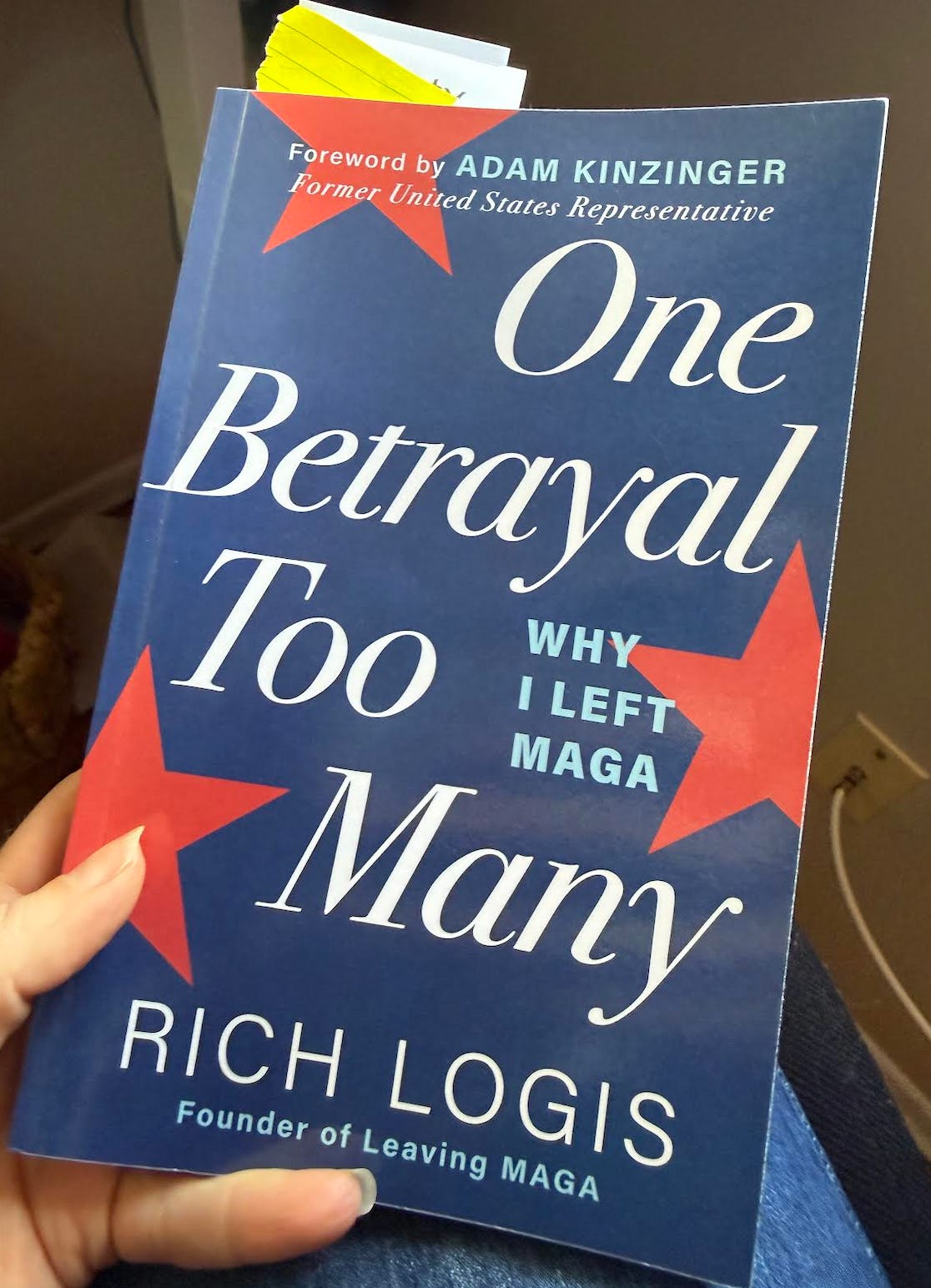
That’s the part Rich Logis writes about in his new book, One Betrayal Too Many: Why I Left MAGA.
Rich wasn’t someone studying the movement from a distance. For seven years he was deeply inside it. He attended events at Mar-a-Lago. He defended Donald Trump publicly. This wasn’t casual political support, it was identity.
One of the moments that stayed with me from the book happens on election night in 2020. Rich describes the confidence in the room as the returns begin to come in, the assumption that victory is inevitable. Then Fox calls Arizona and the energy changes.
Later that night, watching the results unfold, he realizes something quietly but unmistakably. Trump has lost.
And when Trump declares victory anyway, Rich writes that he knew, internally, the claim wasn’t true.
He describes that realization with a word that matters.
Betrayal.
What struck me, and what families for MAGA- identified individuals will recognize immediately, is that this realization didn’t lead him to leave right away.
In fact, he says at that point, he doubled down.
In the book Rich calls the year that followed his “year of heaven and hell.” Instead of stepping away, he defended the narrative more aggressively. He attacked critics. He leaned harder into the identity.
People in the groups I facilitate know this phase very well. It’s often the moment when their loved one seems more rigid than ever, more certain, more reactive.
Psychologically that makes sense. When an identity begins to wobble, the instinct is often to protect it rather than abandon it.
Anthropologists have a word for the stage that comes next. Liminality. The space between identities, when someone is no longer fully inside something but not yet outside it either.
It’s an incredibly fragile psychological place to stand, and it’s usually invisible to the families watching from the outside.
Rich’s story isn’t just about leaving a political movement. It’s about the long process of reckoning that follows when someone realizes they were wrong about something that once defined them. And then, he doesn’t simply walk away and say, well, that was then.
He says he’s sorry.
And then he does something you almost never see in public life. He devotes himself to making amends. Rich founded Leaving MAGA, an organization dedicated to helping people disengage from political extremism and rebuild their relationships with family and community. The groups I facilitate for families are offered free through that organization, and every week I see people trying to navigate the emotional wreckage that ideological extremism has left in their lives. (Find out more and come join us FREE HERE)
Watching someone attempt to repair harm, not rhetorically, but through sustained action,is rare enough that it’s worth noticing.
Rich could have simply gone on with his life. Instead he chose something harder. He decided to help other people find their way out.
There’s something quietly miraculous about that kind of transformation. Not miraculous in a magical sense. Miraculous in the sense that it reminds us human beings are capable of changing, even after they’ve contributed to harm.
In our conversation on Peace and the Power, Rich and I talk about what that process actually looks like. The first crack in belief. Why people often double down before they leave. The fragile psychological space between loyalty and doubt. And what families can and cannot do if they hope to keep the door open.
If you are someone who loves a person inside the movement, this conversation may help you understand what might be happening beneath the surface.
And if you are someone who has begun to feel that quiet crack in your own certainty, Rich’s story may feel uncomfortably familiar.
Here’s my conversation with Rich Logis, originally aired on Frontline Voices On WBAI 99.5 FM NYC: